
notes for when i overthink
Becoming the person who just does things

There’s a move in the ashtanga yoga sequence called a “dropback.” You arch backward from standing, reaching for the floor behind you until you’re in a full backbend. Then you use momentum to spring back upright.
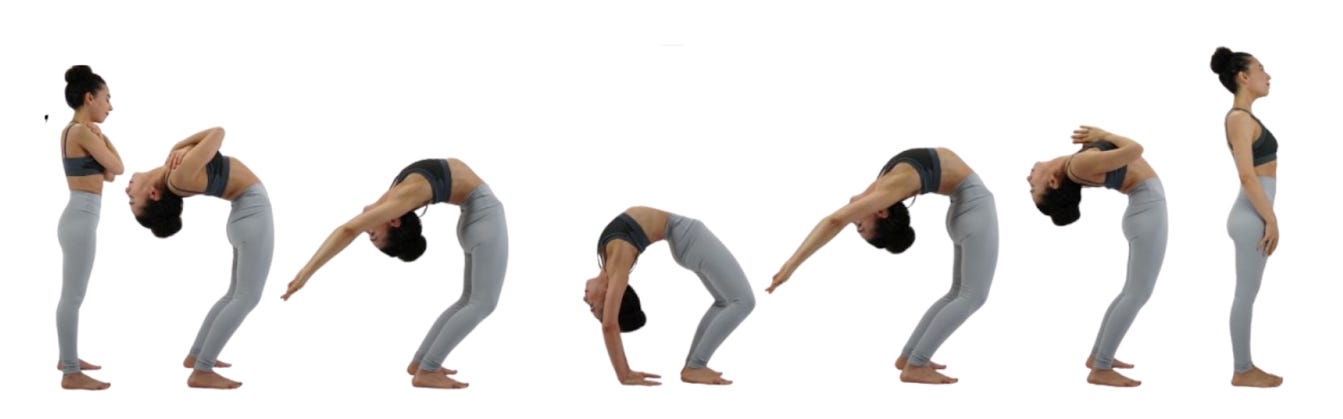
“By the time I let you attempt this, your body is ready. Your spine has the flexibility. Your shoulders have the strength. The only thing stopping you is your mind,” my teacher Cheuk Na used to say.
And she’s right.
If you pause halfway (which means: if you let your brain notice you’re falling backward) every muscle goes into panic mode. You stiffen, wobble, and either abort entirely or collapse in an ungraceful heap.
But if you ride the momentum - bending, reaching, trusting your body to find the floor - you drop and come up lightly, almost without effort.
I spent months and months overthinking this move in exactly the same way many of us overthinkers overthink big life decisions. Does this pattern sound familiar?
One: You feel that insatiable urge to do something BIG. Change careers. Start a business. Move countries. Ask someone out. Leave a relationship that runs its course.
Two: That brief, electric period where momentum builds. Your mind is alert at 2am. You can see exactly who you need to call, what you’ll say. Desire is strong, the idea feels charged. You can taste possibility.
Three: Then something sensible yet threatening happens. You don’t want to be reckless. You’re too reasonable for that. You can’t just uproot your life due to shiny object syndrome. So you decide to think it through properly. Like a proper adult.
You gather data, you seek opinions, and then a flood of imagined disasters comes crashing down. Oh, turns out your great idea wasn’t so great after all. Your boldest dreams die in the morgue of your own mind, suffocated under imagined disasters.
The question of this piece: How do you become someone who just does things? Who avoids overthinking without being reckless? Who lives their dreams simply because they act before they overthink?
The Three Zones of Thinking
I think the dropback holds some answers. You need enough awareness to move safely, but not so much that you lose the momentum that makes the move possible. This means that the “appropriate” level of thought is the amount of awareness you need to execute the move safely and fluidly. Not so little that you get hurt. Not so much that you freeze.
In yoga, you don’t need a philosophy degree to know when you’re overthinking the dropback. Your body tells you. You’re rigid, your breath is shallow, and you can’t move. The same is true in life: overthinking reveals itself through paralysis, not analysis.
The Overthinking Zone
In the dropback, overthinking looks like this: You’re standing at the top of your mat. Your teacher is watching. Your hands are already sweating. You catalog every disaster: hyperextended shoulders, compressed vertebrae, the humiliation of collapsing in front of the advanced practitioners behind you. You shift your weight. You breathe. You shift again. 3 minutes pass. Then 5 minutes. You never actually drop back.
In life decisions, overthinking is your mind looping in analysis beyond what the situation demands. You collect more and more information but never feel “ready.” You focus on what could go wrong far more than what could go right.
It’s spending weeks researching neighborhoods before potentially moving countries, creating elaborate spreadsheets. It’s speaking to dozens of people about career changes without ever taking a single concrete step toward actually making a change.
In the overthinking zone, opportunities pass while you’re still “researching” them. Your confidence erodes because deep down, you know you’re using analysis as sophisticated procrastination. The most painful cost is the opportunity window closing: by the time you finally act, the landscape has shifted.
The Underthinking Zone
In the dropback, underthinking looks like throwing yourself backward because your ego won’t let you look scared. No warm-up. Core disengaged. Hands reaching blindly for a floor you haven’t checked is actually there. You might get lucky once, twice. But eventually: compressed vertebrae. Hyperextended shoulders. Or worse.
In life decisions, underthinking is acting without engaging with relevant risks, information, or consequences. You make decisions in the same conversation where you first hear the idea. You say “yes” because you’re bored, pressured, or chasing novelty.
It’s quitting your job without thinking through the finances, moving countries without considering what you’re leaving behind, investing your retirement fund in your cousin’s cryptocurrency scheme.
In the underthinking zone, the cost is rash action that creates avoidable messes. You spend your energy putting out fires instead of channeling your energy into something you value. Like the careless yoga student, you might get away with it for a while, but you're setting yourself up for painful consequences.
The Just-Right Thinking Zone
In the dropback, just-right thinking looks like warming up properly, engaging your core, and extending your spine. You know where your hands are going to land. You’ve checked that your breath is steady. But when it comes time to actually drop back and come up, you let go of the mental chatter and trust the process. You ride the wave of momentum your preparation has created.
In life decisions, just-right thinking is acting before momentum fades. You gather only the data needed to test the idea safely. When you want to test living in a different country, instead of endless spreadsheet analysis, you book a ticket for a two-month trial run. When you’re considering a career shift, instead of interviewing 100 people in the target industry, you start a side hustle to test both your interest and aptitude.
In the just-right thinking zone, the potential cost and benefit of actions balance themself. The action is small enough to reduce risks but quick enough to be informative. You’re bold but not reckless. You're thoughtful but not paralyzed.
When You’re Still Stuck
Understanding the zones helps. But sometimes you’re standing at the top of your mat, you know your body is ready, and you still can’t make yourself drop back. Here are some notes for those moments:
Honor the momentum window. There’s a brief period after inspiration strikes (48 hours? maybe 72 if you’re lucky?) when action feels electric and natural, before fear and over-analysis calcify around it. This window is sacred. The moment an idea excites you, commit to one concrete action before it closes. Send the email. Book the ticket. Have the conversation. Miss this window, and even the smallest viable action becomes infinitely harder to execute.
Inside that window, if you’re still frozen: borrow someone else’s energy. Think of someone who’s done the thing you’re afraid of—someone specific, someone you’ve actually seen in action. Channel their energy completely as though you were full on method acting for ten minutes. Move like they would move. Then do the smallest action while wearing their confidence.
And if you’re still stuck? Count to three and go. There’s a scene in We’re the Millers where a dad teaches an awkward teenage Will Poulter how to approach the girl he likes: just count to three and kiss her. Yep, no perfect pick-up line suggestion from Dad. Sometimes the most sophisticated tool is the simplest one.
The pattern in every successful move from inspiration to action is the same: small enough to reduce risk, quick enough to maintain momentum, real enough to be informative.1
Learning to Unthink
It sometimes feels like I was born an overthinker, then trained to overthink even more thoroughly. It served me well in many areas of life. I’m often complimented for my “critical thinking skills.”
But in other domains, this ability to overthink hasn’t been helpful. There are small things like taking 4 (!!) tries to pass my driving test because I couldn’t fathom controlling this lethal machine without understanding how the clutch engaged the flywheel. Turns out you don’t need a mechanic’s understanding to parallel park confidently.
Then there are bigger things: I almost closed off some of the most meaningful relationships in my adult life because I ruminated too long on “compatibility”, even though everything in my heart was saying yes, yes, yes.
This ability to use my brain has been both my biggest asset and my biggest liability.
Maybe for many of us, the qualities that got us where we are today eventually become the biggest blockers to where we want to go. Growing/Wising up becomes a matter of unlearning the things that have served us so well.
There are people with half your skills and intelligence living your dreams right now. Not because they’re braver or smarter. Because they’ve learned to act within their momentum window. They drop back before their brain talks them out of it.
My teacher was right: by the time the opportunity arrives, you’re ready. Your body knows what to do. The only thing stopping you is the story you’re telling yourself about all the ways it could go wrong.
The next time you feel that familiar spark of inspiration, that moment when possibility feels electric and real, remember: you can do it too.
Breathe. Align. Drop. Come back up. Breathe again.
—
Ines x
Thanks for reading! If you enjoyed this, you might also enjoy:
This pattern shows up across domains once you start looking for it. In business, it’s called the “minimum viable product,” launching with just enough features to test with real users rather than perfecting in isolation. In science, researchers use “minimum viable experiments” to test hypotheses quickly before committing to expensive long-term studies. Becky Isjwara talks about “minimum viable content,” meaning publishing your rough draft instead of endlessly polishing, because the feedback from putting work into the world teaches you more than another month of private editing ever could.
I've never come across an explanation if what's between overthinking and under thinking before! This is brilliant. It's often so much harder to aim for something u defined, so this will be helpful to a lot of people.
Also, this line makes me think that "just right" thinking is actually just trust in oneself: "In life decisions, just-right thinking is acting before momentum fades. You gather only the data needed to test the idea safely." You know how much data is needed to test the idea safely when you can imagine the potential setbacks and how you'd respond to them. So that amount of data will be different for everyone, but the feeling behind "that's enough data now" is the same - it's the feeling that you can ride whatever waves come your way.
I liked this.
love the concept of a minimum viable window of action and how practical the tips for when you’re still feeling stuck are! will def be implementing these in my life