
a mini guide to self-employment
5 lessons from 6 months+ working for myself

Over six months ago, I left “traditional” employment and started working for myself. Since then, I’ve had the chance to work on a range of projects with interesting people: a research project on how AI is affecting jobs; helping an author launch a book published by a Top 5 publishing house; writing a weekly science newsletter for a YouTube channel with 20+ million subscribers; and more.
On paper, it looks like it’s going okay. I enjoy the work. I’m lucky to be able to choose projects that interest me. I love the autonomy, the variety, and (not to be underrated) the absence of pointless meetings (often, about meetings).
Yet I’ve been surprised by how much self-doubt comes bundled with this flexibility. Questions I never had to ask in traditional employment now rattle around regularly: Where is this going? How do I explain what I do? Should I be trying to turn this into a “real” business - productize a service, hire a team, scale?
And, most concerningly, am I losing the skills that I might need if I were to re-enter traditional employment (managing teams, navigating organisations, playing the politics inside an institution)?
In this piece, I want to reflect on some lessons from these past few months. Hopefully, it’ll be useful for those who are on this path or considering it - the number of which, I suspect, is about to grow for reasons I expand on below.
What Is Self-Employment?
Before we go further, let me be clear about what I mean by “self-employment”.
Picture a spectrum. On one end: traditional employment, where one company gets all your time in exchange for a salary, benefits, and a place on the org chart. On the other: founding a company: building a team, bringing a product or service to market at scale, maybe raising money.
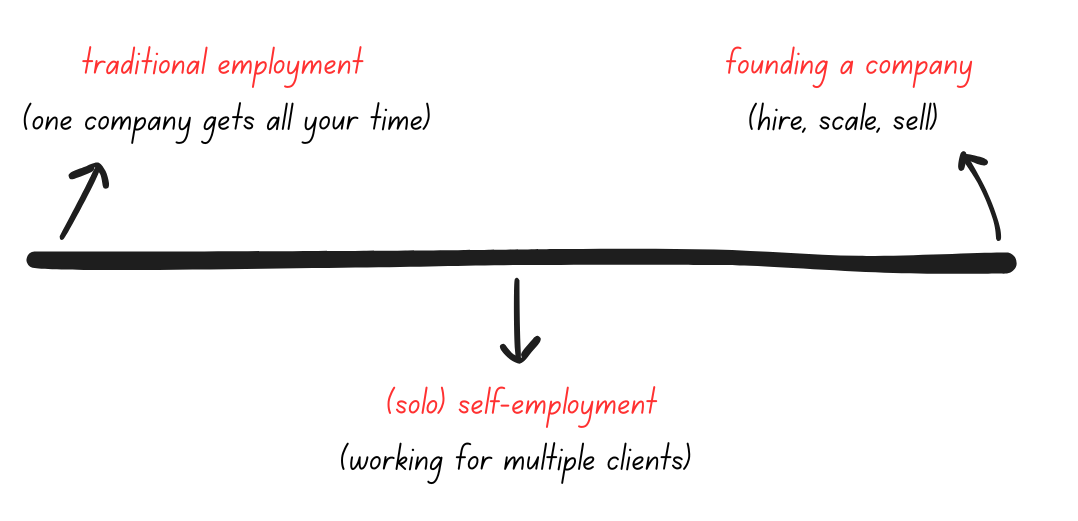
When I say “self-employment” in this piece, I’m talking about the middle ground: working for yourself, with multiple clients, getting paid for projects or outcomes rather than hours on a clock. You might call it freelancing, independent contracting, or consulting. The label matters less than the structure (though finding the right label remains a persistent bugbear of mine!): you’re not (yet) building a company with employees, but you’re also not someone else’s employee.
Each path comes with different benefits and trade-offs.
Traditional employment offers security: a predictable paycheque, pension contributions, parental leave, health insurance (in the US), protection from unfair dismissal (in the UK).
Typically, self-employment trades security for flexibility. You choose your projects, set your rates, and decide when and where you work. But there’s no pension unless you build one yourself. No parental leave. No safety net if a client disappears. And in the UK, you need two years of accounts to get a mortgage as a self-employed person, compared to three months of payslips for the traditionally employed. That difference tells you something about how institutions assess the relative risk of each path.
More People Are Becoming Self-Employed
I suspect more and more people will find themselves on this path of self-employment. In fact, the shift is already underway.
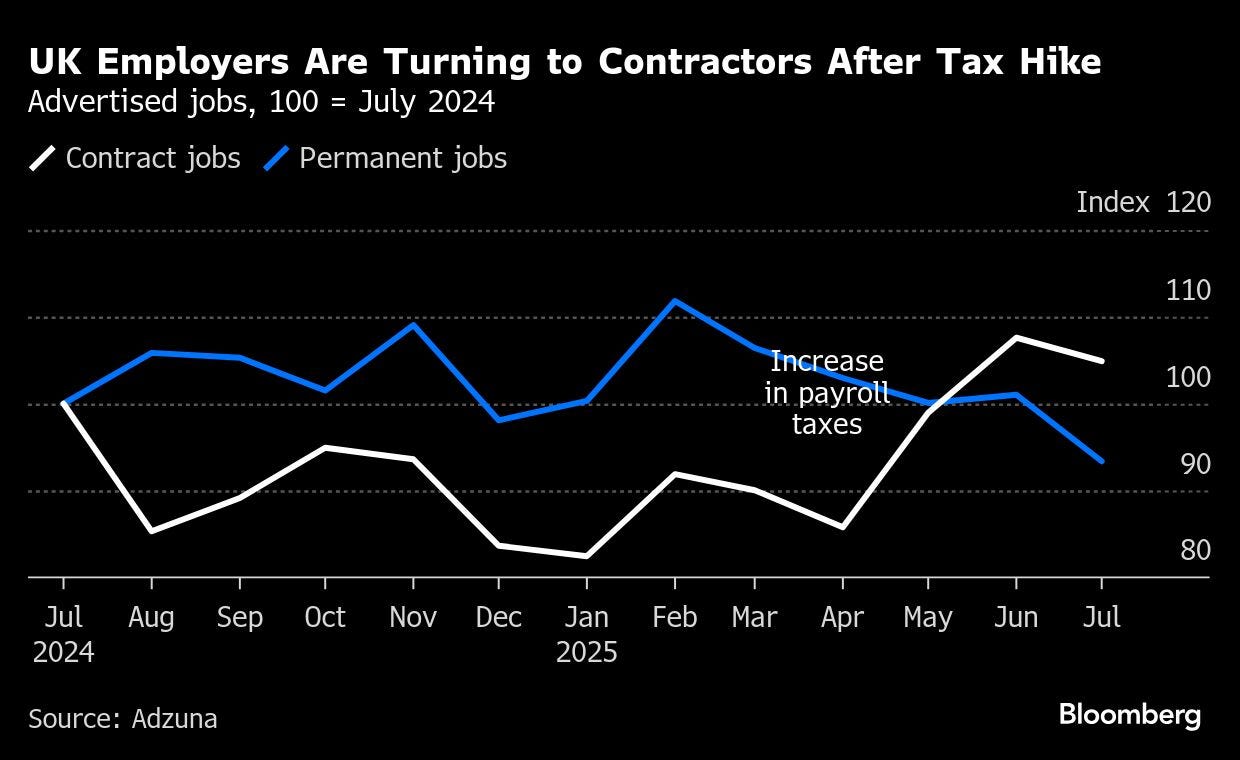
In the UK, professional freelancing has grown 48% since 2008, while overall employment grew just 12% over the same period. Contract job postings - roles explicitly advertised as fixed-term or project-based rather than permanent - are up 22% since April 2025 and permanent vacancies are down 9%.
In the US, nearly 30% of skilled knowledge workers now describe themselves as freelance or working in non-traditional arrangements. When the Bureau of Labor Statistics asks independent contractors whether they’d prefer a “traditional” job, over 80% say no. They prefer what they have.
Why is this shift from traditional to self-employment happening? There’s a mix of push factors (=companies choosing it) and pull factors (=employees choosing it) driving this trend.
The Pull: Why Companies are Hiring Differently
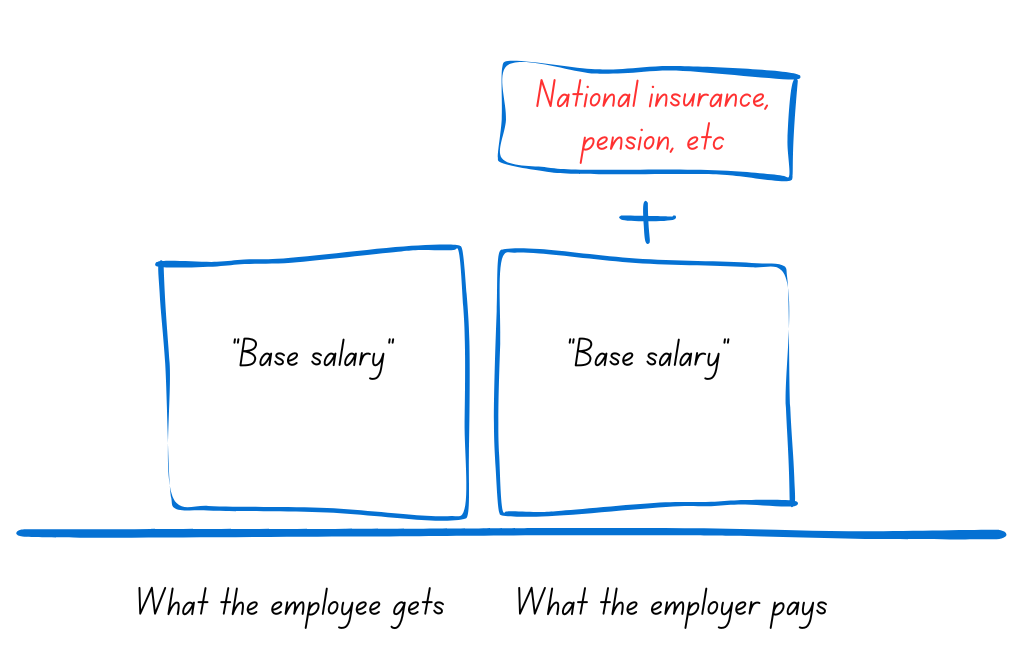
When a company hires a traditional employee, they’re not just paying a salary. They’re paying a bundle of additional costs that most workers never see.
In the UK, employers pay 15% National Insurance on top of every pound of salary above £5,000 per year. They typically contribute to pensions, and often provide benefits like private health insurance, training budgets, and equipment. This means that for a worker earning £60,000, the “true” cost to the employer is closer to £70,000–75,000.1 In contrast, when a company hires an independent contractor instead, most of those costs disappear. They pay the agreed rate, and that’s it.
This creates a meaningful gap from the employer’s perspective.2 So when hiring feels risky for an employer (e.g., when the economy is uncertain and when budgets are tight), employers increasingly prefer to “buy” a scoped deliverable from a contractor than commit to a salary, benefits, and the friction of a future layoff.
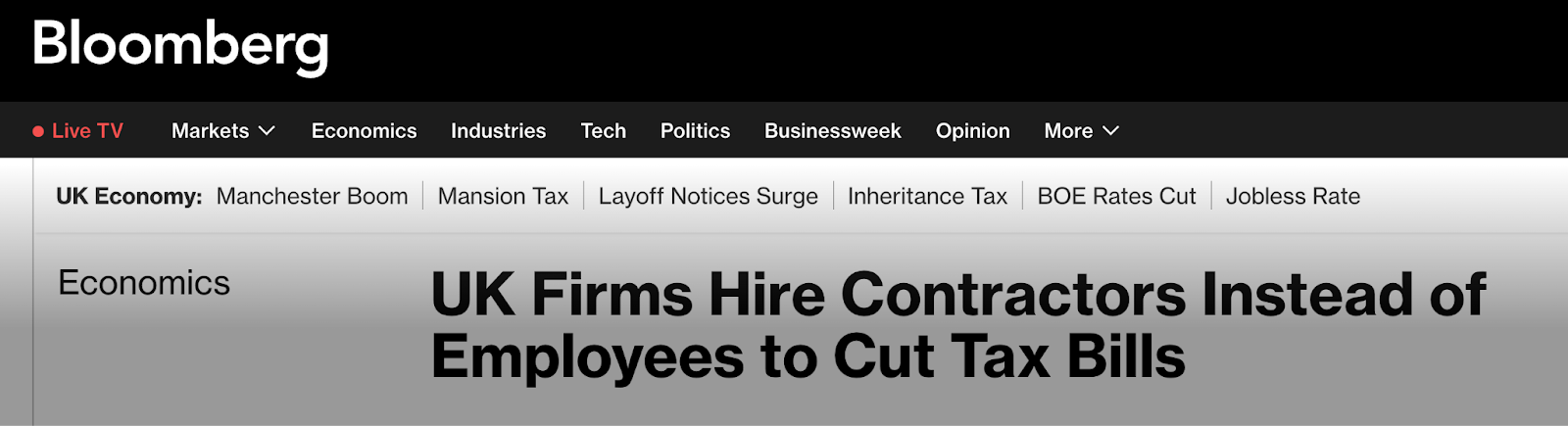
These dynamics aren’t new. Companies have always valued flexibility. But recent changes have widened the gap. For example, in the UK, employers’ National Insurance contributions rose in April 2025, making employees more expensive relative to contractors. Companies noticed, leading to Bloomberg headlines like the one below…
The Pull: Why Workers Are Choosing This
But this isn’t just companies pushing people out of traditional employment. Many workers are actively choosing this path.
A decade ago, “freelancer” often meant someone in the creative industries who couldn’t land a staff job. And the term “solopreneur” was pretty much unheard of. Now, we hear these terms used much more widely, across fields from design to software engineering to consulting.
Autonomy is part of it. The ability to pick your projects, set your own hours, work from wherever you want.
And, of course, AI is accelerating this trend too. A single skilled operator with good judgment and the right tools can now deliver what used to require a small team. That raises the earning power of independents and makes self-employment more viable for knowledge workers who might previously have needed an organisation’s resources behind them.
Caveat: I definitely don’t want to romanticise this. I’m fully aware that for some people, self-employment isn’t a choice but rather what happens when traditional employment isn’t available. (And speaking from my own experience, if one of the “dream” companies that I applied to in early 2025 offered me a full-time position, there’s a very high chance I would have taken it, and I wouldn’t be sitting here writing this article. The freedom narrative can definitely obscure the precarity!)
But for knowledge workers with marketable skills - the camp I suspect many of you reading fall into - self-employment increasingly looks less like a risk and more like a legitimate career track. One that might require a different set of skills than traditional employment demands (something I’ve written about here).
Which brings me to what I’ve learned…
(Another caveat: this list of lessons could potentially be endless. I’m not going to share lessons about logistical things like how to pay your taxes as a self-employed person vs a traditionally employed person. Instead, I’ll break it down into what I think are the top core skills for a self-employed person.)
Lesson 1: Learning to win the work
If you’re the kind of person who studied hard in school, got a good job, and worked for your promotions, you’ve probably spent most of your working life being rewarded for doing the work.
I certainly have. In school, the formula was clear: study hard, perform well on the test, get the grade. In academia, it was similar: do the research, write the paper, submit to the journal.
This is excellent preparation for being an employee. It’s incomplete preparation for being self-employed.
When you work for yourself, doing the work is only half the job. The other half is winning the work in the first place - finding clients, convincing them to hire you, turning a conversation into a contract. None of my years of being a diligent student prepared me for this.
At first, I thought this meant I needed to learn how to sell. I imagined it as a kind of performance: crafting the perfect pitch, projecting confidence, persuading people to buy what I was offering. The whole idea made me uncomfortable. I’m not a natural salesperson (if that is even a thing), and the thought of becoming one felt like wearing someone else’s clothes.
What I’ve learned is that winning work isn’t really about selling - at least not in the way I’d imagined. It’s closer to listening, educating, and diagnozing.
A few months into my self-employment journey, I realized that most potential clients know they need help but they often struggle to articulate what kind of help. I realized that this “fuzziness” about what they need help with is a great opportunity to be helpful. It’s sort of like offering “meta-help” if you will.
This changed how I approach early conversations: Instead of “I’m trying to sell them on X,” I found it helpful to adopt the mindset of “I’m helping them figure out what they need and if it turns out I can provide it, great.”
Sometimes those conversations lead to work. Sometimes they don’t. The person realises they need something different, or they’re not ready to move forward. Either way, the goal is to make the “sales” conversation useful to them. And I’ve found that being sincerely helpful, even when it doesn’t lead to a contract, tends to come back around.
This doesn’t mean you shouldn’t be clear about what you offer. You should. But the selling, such as it is, happens after you’ve helped them understand the problem, not before.
Lesson 2: Define your scope (And defend it)
Early on, I made the mistake most new independents make: I said yes to everything.
A client would ask for something slightly outside what we’d agreed. Sure, I can do that! They’d want revisions on a timeline that hadn’t been discussed. Of course! They’d shift communication to a channel I hadn’t planned on monitoring. No problemo!
None of these requests was unreasonable in isolation. But they accumulated. And I realised that without clear boundaries, I wasn’t actually in control of my work. I was just reacting to whoever asked for something most recently.
When I mentioned this to a more experienced self-employed friend, she asked whether I’d written up a scope of work before kicking things off. This is standard practice among independents: a document that specifies what you’ll deliver, what falls outside the engagement, communication expectations, and what “done” looks like. Both parties sign it. The idea is to create clarity upfront so there’s something to point back to if expectations diverge later.
“Yep, and we’ve both signed it,” I said.
“Okay,” she said. “But are you actually sticking to it?”
Good point. Rookie mistake. As projects ramp up and deadlines approach, additional requests creep in. It’s easy to forget what you originally agreed to - especially on longer engagements. The document alone isn’t enough. You also need a way of thinking about boundaries that doesn’t feel like constant confrontation.
I’ve found a definition from the psychologist Dr. Becky Kennedy helpful here. A boundary isn’t a rule you impose on someone else (“the client won’t ask for things outside the scope”). It’s a commitment you make to yourself about how you’ll respond (“if the client asks for something outside the scope, I will politely decline and point back to our agreement”).
Other things that help which Anna Mackenzie has written in depth about here: maintaining meeting-free days for deep work; limiting communications to certain channels; setting expectations about expected response time.
The client might still ask for things outside of the “scope” you’ve defined. That’s their prerogative. But you’ve already decided what you’ll do when they do. This small shift - from trying to control others to governing yourself - makes boundaries feel less like confrontation and more like clarity for yourself.
Lesson 3: Think like a co-founder, not a contractor
There’s a subtle but important difference between two mindsets:
Contractor mode: “What do you want me to do?”
Co-founder mode: “What does this project actually need?”
In contractor mode, you get told the task, do the task, and hand it back. You take ownership of your slice of the work, but you don’t connect it to the larger picture. The client’s business strategy, their constraints, their real goals is not your concern.
In co-founder mode, you ask: what does the client actually want here? What actions make sense given the goal? You take ownership of outcomes, not just activities. You think about what would actually make this succeed, even if it’s not what the client initially asked for. You bring options, not just execution.
Adopting the co-founder mindset increases your value. You become a strategic partner, not just a pair of hands. I’ve also found that I get more out of the work this way. Thinking like a “co-founder” inevitably requires understanding the larger business, which means I’m learning more, not just delivering more.
But wait. Doesn’t this contradict everything I just said about defending your boundaries?
On the surface, yes. But I think there’s a distinction between how you think and how you act.
Thinking like a co-founder doesn’t mean literally acting like one (you probably don’t want to if you’re not getting rewarded for it!). It doesn’t mean overinvesting your time, blurring the edges of the engagement, or working weekends because you care so much. It means bringing strategic thinking to whatever scope you’ve agreed to.
These days, here’s how I’m trying to hold both: my scope of work defines what I’ll deliver and when. That’s fixed. But within that scope, I try to think like an owner. This means trying to ask questions about the broader context, flagging when I think we’re solving the wrong problem. I suggest alternatives that the client hasn’t considered. Usually, this doesn’t require working more hours, but it does require working with more thoughtfulness and intention.
Lesson 4: Design your own curriculum
One thing I miss about full-time employment is the ambient learning - the stuff you absorb without deliberately trying. The way you learn by overhearing how other people approach their work. The casual conversation before a meeting where someone mentions an article they’ve read. The offhand feedback from a colleague who watched your presentation.
I’ve found the standard advice to “solve” this problem underwhelming: have coffees with others in a similar situation, join a community, take a course. These help a bit. But I’ve found that they don’t fully replace the shared context you have with colleagues who are fighting the same battles, seeing the same problems, building understanding together over time.
Also, when you’re employed, your professional development is partly the company’s responsibility. They have an incentive to grow you because they benefit from your development. When you’re on your own, that responsibility is entirely yours. No one is going to design your curriculum. But self-directing your learning as an adult is hard - especially without the structures of a job that specifies certain learning milestones (e.g. accounting qualifications).
I haven’t fully solved this. But I’ve developed one practice that seems to be helping: I try to have one “learning” project going on that has little or nothing to do with client work. Recently, that was a fiction copywork course (hand-copying passages from writers!) and learning about public finances in a post-AGI world (lol). Both learning projects were tangential to what I’m getting paid for. But it makes me feel like I’m growing in a direction of my choice, not purely responding to whatever lands in my inbox.
Lesson 5: Your character is your product
“I like working with you, Ines. You’re very level-headed. You’re never alarmed.”
A client said this a few months into working together when we were fixing a problem, fast. It was a small comment, almost throwaway. And I didn’t realize how much it’d mean to me until I found myself thinking about it months later. It felt like a judgment about who I am to work with, rather than just a comment about the quality of my work.
It’s hard, maybe impossible, to capture your character neatly on a CV. But I increasingly think that, past a baseline level of competence and technical skill, character rather than just pure skill is the thing that keeps clients wanting more from you.
When you’re self-employed, there’s no institutional brand buffering your reputation. You might mention past clients or employers for credibility, but for the most part, what people are getting is the direct experience of working with you. Your responsiveness. Your trustworthiness. Your steadiness under pressure. Whether you’re someone who makes their life easier or harder.
I’ve learned this lesson in reverse too. On one project, a client gave me feedback I disagreed with. Rather than addressing it directly - asking questions, trying to understand what wasn’t working for them - I leaned avoidant. I submitted a slightly altered draft without really engaging with what they’d said.
While my reaction didn’t have any noticeable negative impact on our relationship, it did “cost” me in a way that’s harder to measure - perhaps their confidence that I was someone who could handle honest feedback. That’s the kind of loss that doesn’t show up on an invoice but does matter in the long run.
Kevin Kelly has a line: “Being enthusiastic is worth 25 IQ points.” I’d extend it. Being steady, being trustworthy, being someone who doesn’t make problems worse, being a person others can think out loud with, being someone who takes feedback without defensiveness - that’s worth as much as the credentials and experiences you’ve accumulated.
~~~
Over six months in, I still don’t have confident answers to the questions I raised at the start of this piece: where is this going, am I losing skills, should I build a “real” business?
What I am confident about is that I’m getting the opportunity to practice skills that I didn’t practice as much in traditional employment: winning work, holding boundaries, taking ownership without being asked, designing my own learning, and showing up in a way that makes people want to work with me again.
That sort of feels like progress, even if it might be hard to name it on a CV.
—
Ines x
If you enjoyed this piece, you might also want to check out:
In the US, the picture is similar. Employers pay 7.65% in FICA taxes (Social Security and Medicare) on every dollar of wages. Add health insurance, 401(k) matching, unemployment insurance, and workers’ compensation, and the total cost of an employee runs 25–40% above base salary. A $60,000 employee might actually cost the company $75,000–85,000.
There are other advantages too: contractors can often be booked against project budgets rather than headcount, they hit the ground running without onboarding, and the engagement ends cleanly when the work is done (hence you don’t get things like severance pay).
/bookmarking this for when i eventually take the leap
gosh i wanna be like you when i grow up
Particularly resonated with the reorientation of what sales looks like. It’s also applicable for traditional BD work and corporate jobs where your ‘clients’ are internal stakeholders.
My mindset shifted when I saw team leads approach potential projects as the client’s coach and advisor, rather than a salesperson. The client’s first “why we want this project” often doesn’t tell the deeper story. Going through this process helped me realise sales is a series of conversations to understand the client’s true context, and a candid assessment on whether we can deliver what they need. We often won trust points by talking a client out of work they should not be doing at that moment